Showing posts with label agriculture. Show all posts

Saturday, 3 September 2011

Is She Pregnant?

It's been a while since I've blogged, life's been busy and the days are very quickly disappearing until I have to go back to school and this thought does not excite me all that much. A few weeks ago now we performed one of my favorite jobs to do on the ranch which included preg testing our cows and heifers! We spent the better part of four days checking if our 612 females are going to have a baby next year, with 450 being cows and 162 heifers.

It was a busy few days but a few years ago we would preg test all our females in one day when the vet did it. Now, that day was long, it would start at about six in the morning and end late that night. When our vet however retired from preg testing cows, my dad and neighbor teamed together and bought an ultrasound machine to preg test with. So, we have been using it for the past few years, so we are in no rush to finish preg testing in a day, with the machine it also takes a few less people. When the vet came we would have a couple people on quads going to get the next group of cows because we didn't have time to lose waiting for cows whereas now it's not such a big deal to have them their right away.

Screen, big circle on bottom left is 91 days, small is 63
and circle on right is 77 days pregnant.
The machine is a simple probe with a camera on the end that will show a picture of the fetus. With the settings on the screen you can see how long the cow has been pregnant for my measuring the fetus and comparing it to the circle on the screen. Some people preg test to simply find out if the cow is pregnant or not, we however want to find out about what time she is going to calf, so we measure the baby. The time taken varies for each cow, some are done in a second, others take a while longer. It's easy to see if a cow is pregnant but it's the open ones (open meaning not pregnant) that can be hard to decipher.

With my dad preg testing, we usually had our hired hand on the head gate catching the cows in when they came in, my brother was in the back keeping the chute full of cows, continually chasing them in and I had the wonderful job of paperwork. This includes writing down the weight of the cow and the number of days pregnant. I also had to make sure I payed attention because on some of the cows we had AI dates, or some also had seen bred dates, if they had any of these I had to make sure that I told dad the date because a lot of the time that was the date that the cow got pregnant and instead of having to come up with a number of days, I could just highlight that date if it was the one.

Paper looks like this, with cows number followed by the AI date/Sire, Exposure date/Sire/Seen Bred When,
Second Exposure Date, days pregnant and weight.
It is quite a process, but a fairly enjoyable one and the equipment has worked real well for us over the years, it's nice cause we have the leisure to preg test whenever we want and I think it's more comfortable on the cows too, when a vet preg tests the cows will walk around with their tales up for a bit whereas with the probe they hardly notice and just walk out of the chute like nothing ever happened. Definitely one of my favorite times of the year and I just can't wait until winter when all those little babies are born into this world!

If you have any questions about preg testing or anything please don't hesitate to ask!

Friday, 26 August 2011

Silaging

 
Chopper
After the Hardisty field day which was another wonderful and good day we came home and plowed full swing into silaging! We silaged for four days and covered the pit on Wednesday morning. It makes for a busy few days from about eight in the morning to ten or eleven at night and is a very important time as silage is what we feed in the winter months to our cattle and are their main food.

This year we had a very large silage pit, we silaged more crop than we usually do because we got a bunch of winter kill on the alfalfa so it didn't come in very well so instead of haying it we silaged it. Silaging is also a process that takes a few people to successfully complete it. Every year we get together with our neighbors and we help them silage their crop and they help us silage ours. Most of the time you need:
  • 1 person swathing a bit ahead of the chopper
  • 1 person running the chopper
  • 1 person on a tractor packing down the pit and moving the silage up
  • 3 or 4 people driving trucks depending on the distance of the field.
Pit


 Now once the silaging is complete we have to cover the pit so that it doesn't get any air or moisture so then it doesn't rot. There are a couple ways to cover pits. Lots of people cover pits with old tires onto the plastic, it is a lot of work to move tires and cover the pit. We used tires back when we would bag the silage and you would just have to do the ends of the silage bag. When we starting putting the silage in a pit however we have covered the pit with big round bales. We find this works wonderful, it gives the pit a good seal and we haven't ever had issues with the silage spoiling. It is also less strenuous on the people, we have a couple people in tractors moving bales and then three our four on the ground holding the plastic down. The ground people don't have to do any heavy lifting or anything and it is much nicer. I have covered silage with both tires and bales and I must say I prefer bales much more than tires.
This is the amount of silage above the pit edge. 

So, we successfully got another crop of silage of the ground and by the looks of the pit it should be more than enough to feed our cows during the winter. I also got to smell the sweet aroma of fresh silage for a couple days, a smell that I quite enjoy. Some people don't like the smell as much, but I quite enjoy it now anyway, not so much when it's older.


Complete

Wednesday, 17 August 2011

Boy from Girl

Headed Home
A little while ago we sorted all four hundred and some of our cows, we do this every year around this time when we have a spare minute. We sort the bull calves from the heifer calves or boy from girl for one simple reason, to prevent any 'teenage pregnancies' so to speak. It is more than likely not going to happen, but because we have so many cows we can sort them apart and its just a precautionary measure and much safer. The bull calves will also ride the cows if their in heat, they can't really hurt the cows. But the bull calves will also sometimes ride the heifer calves which could injure them so we sort them annually.

Once we sort them girl from boy, we go through our bull calves again and sort out the better ones and put them in a separate group. Dad finds this works great if someone stops in to look at cattle and they only have a few minutes, we will take them to the group of better bull calves. Around this time of year we also attend field days, which is a day where breeders bring bull calves and they are judged in a ring openly. These are the kinds of shows my dad loves, not very much work all you do is bull your calves of the pasture load them on the trailer and take them to a field day for the day. This year we sorted out 24 good bull calves for two field days and 12 heifer calves which are split into pens of three and judged by the people at the field day.

The north western field day was last week in Cut Knife, Saskatchewan. It was a wicked long day, it takes about six and a half hours of straight driving to get there, so we left here at 4:45 in the morning and got home at about 2:30 in the morning the next day, so all in all it was a long day for us and the calves who were very happy to see mommy. It was our first time to the North Western field day and we ended up with Champion Senior Bull Calf and third in the pens of heifer calves. So, it was worth it and it is a great way to see people in the Hereford business and their cattle. I thoroughly enjoy field days. Unfortunately I did forget my camera so I don't have any pictures but I hope to take some for this Thursdays field day in Hardisty, Alberta (a little closer to home, about 4 hours).

Our sorting of boy from girl lets us kill two birds with one stone when we pick calves for the field days and it is a precautionary measure to prevent stuff we don't want to happen!

Monday, 11 July 2011

Bull Pulling!

Well, it has been an extremely busy last few days! The big thing this weekend was that the breeding season at our place is officially over, except for the commercial heifers. So, the better part of Friday and Saturday in between baling hay was spent pulling bulls and moving cows. The way we do this is by pulling the bulls from each place separately and then locking them up in a pen of some sort alone also. Once we have all of them rounded up from the pastures, which was done over a two day time span this year we chase them out to a field separately too. We have this one fairly large pasture that is just across the road from our house, it has a slue in the middle, and it gives the bulls lots of room to spread out. We chase them out separately so that they aren't fighting in the process of chasing them out!

We send them all out separately but at the same time so that they can all get used to each other at once. If you have a group of bulls and then you just add another one sometime later sometimes they will gang up on the bull that is new. So, our herd bulls spent the first day or so fighting to see who would be the boss of them all, it's just what they do and is quite natural. But, after a while they do settle down and that is why they are also in a big field so they can spread out if they have to and close to home so that we can check on the regularly to make sure no one gets injured or sick in the chaos. We also moved some cows together, as it is a whole lot easier to check eight or nine bunches of cows rather than seventeen of them, and now with the bulls gone we can put more of them together.

 So, that was the big deal this weekend, another breeding season is over and new life's are growing. Sunday was spent with the extended family celebrating a Birthday and Graduation but he rest of the weekend and Monday was mostly spent haying and getting ready for the big Summer Synergy Show. It's been a busy couple of days but not as busy as the rest of the week is going to be!

Friday, 8 July 2011

A Day of Golf

I spent Wednesday and Thursday up in the town of Hanna at the Keith Gilmore Foundation Annual Golf Tournament! We headed up on Wednesday for the Alberta Hereford Association Annual meeting which my dad was part off, and we enjoyed either a steak or broil lobster supper. The country girl that I am, I stuck with the steak, but I did try a little piece of the lobster and it was edible and from what I heard some of the best lobster people had ever had!

Thursday consisted of the big day with the golf tournament. I golfed for the third time in my life, now the first time I golfed was when I was about six and I don't remember it much, and the second time was in grade twelve, glow ball golfing and that was pretty much just whacking the ball around all over. So this was my first time golfing for real, a full game and I must admit I quite enjoyed myself. I learned a few things, I suck at driving the golf ball, however I am a pretty good putter and golf is funner to play then it is to watch on TV, although it is still not my first pick of a sport but it's fun every once in a while! The day was ended with a wonderful steak supper and a live auction with all proceeds going to the foundation!
Daniel was practically a pro at golfing.

The golf tournament is a fundraiser for the Keith Gilmore Foundation, which is a foundation that gives up to ten scholarships to post secondary students in Canada that are in the fields of agriculture, veterinary medicine, and agriculture journalism. I was one of the recipients last year, so I was asked to give a little speech about myself this year, so I had to go up their anyway so I decided may as well do a little golf. It is a great day spent with friends having a little fun golfing, and for a very worthy cause.

For more information on the Keith Gilmore Foundation go here and if you are a Canadian student taking post secondary in agriculture apply for the scholarship, every student likes scholarship money!

Wednesday, 29 June 2011

Gophers!

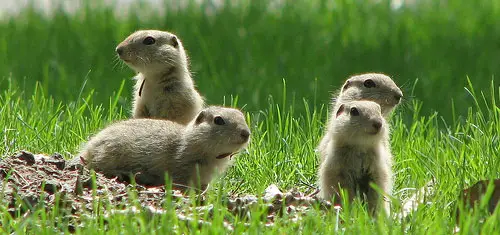
There is a little rodent that runs around called a Richardson Ground Squirrel but I are most commonly referred to as gophers. They cause havoc and are a bit of a problem in the agriculture industry. We have thousands and thousands of gophers in our pastures and we do have to do something about it to control them. Some of you may not agree with killing them but I have to give you my side of this problem. Gophers do two things that cause problems:
  1. Gophers dig holes - They dig them everywhere, making mounds of dirt and tearing up grass. This is an issue in the well being of our cattle, they can hurt themselves if they walk in a gopher hole. It becomes more of an issue during breeding season when they ride each other, it's easier to hurt themselves if they step in a hole while riding.
  2. Gophers eat grass - They eat grass and pasture land, basically what our cows eat. Now one little gopher doesn't make much of a difference, but all together they do. A gopher weighs about a quarter of a pound, and will eat about seventy-five percent of their body weight. So, 0.25*0.75=0.1875 pounds a day. If their is just 1000 gophers together they are eating 0.1875*1000=187.5 pounds of grass. Now cows will eat about 1.4-4.0% of their body weight a day depending on the quality of food. So a 1200 pound cow would eat between 17-48 pounds of dry basis feed. So, just a thousand gophers, are eating about 11 or so cows feed a day! That is a lot!!
Image
So, we do get rid of those annoying creatures, and there are a whole lot more than just 1000 of them, we have one field this year that is really bad, with thousands and thousands of them. And it doesn't seem to matter how many we get rid of, next year there is always another million of them. They are like a never ending problem in our area that we try to take care of as best we can!

Tuesday, 28 June 2011

A little Supplementation!

As I've mentioned before all our cows are out on pasture for the breeding season and they have been keeping us busy with regular checks. Checking everyone on a regular basis is very important to make sure all animals are healthy and making sure they have pasture, moving them when they run out.

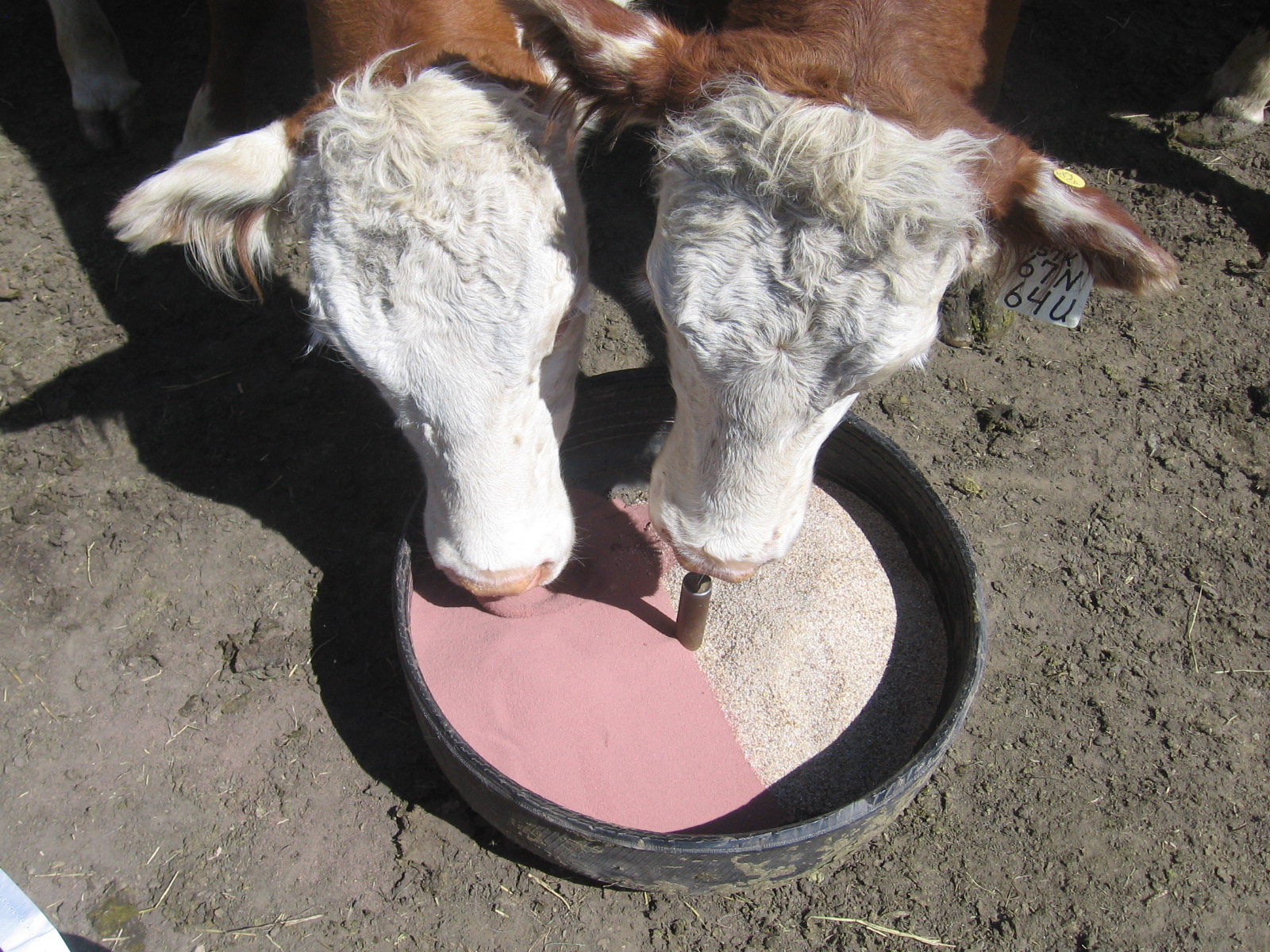
Salt (red) and seven way

On a regular basis we also fill up tubs with mineral and salt as a supplementation and is very important to the cattle's diet. We have three different types of mineral that we give the cows:
  • Our soil is extremely low in cooper and zinc so we feed them a hi-boot cooper and zinc salt that supplies them with the loss in the feed they eat. It also has traces of magnesium which is also a deficiency in cattle.
  • The mineral we feed with the salt is an ALT-GEN 17-17 Beef and Range Mineral which contains mainly calcium and phosphorus for the cattle's diet.
  • Some of our pastures contain alfalfa which is a legume plant that grows purple flowers and will grow several times during the summer if grazed down. One problem that alfalfa can cause though is bloat in animals, which is when the stomach becomes overstretched by excess gas content and if not caught and treated quickly the animal will usually die. So to prevent this cows in alfalfa pastures get seven way mineral which contains vitamins and minerals that prevent bloat.
These supplements are very important to a cows diet, especially during summer pasture and when lactating milk to raise their calves. So, it is very important to make sure that they have a constant supply of salt and mineral. And luckily the cattle absolutely love the stuff, it is usually a mad dash when giving them mineral to get to the tub first!


Monday, 27 June 2011

Invention Monday - Shredder

shredder3bales.jpg (9521 bytes)A truck with a mounted bale shredder that we bought because the prototype that they built took to long to iron out so we went ahead and bought a Brandt Bale Processor for the back of the truck. This wonderful truck has three uses, we can feed grain out of the box in front of the shredder, it can be used to feed hay to the cattle and it shreds straw which is what we probably use it for the most. Pretty much all winter long someone is shredding straw into the pens.

shredderworking2.jpg (10691 bytes)Another sweet feature that my relatives came up with is they added a fork to the front of the truck so that there can be three straw bales loaded on at once, one in the shredder, one at the back and one at the front. This tends to safe quite a bit of time, so then you don't have to drive to the stack yard and get another bale every time you run out but simply push a lever and the next straw bale goes into the shredder.

This invention is one that saves a fair about of time and one that we use a lot. I have never had the privlege of driving this big truck, I have however had the honor of opening gates in cold weather for the person in the shredder so that it would save even more time. Unfortunatly the shredder has been in the shop for a while now getting fixed, hopefully it willwork again soon because it is a pretty important part of the ranch, especially come winter time so the wonderful cows and calves don't freeze! Here is a little video of the truck in action.


 For more info on this great machine go here.

Sunday, 26 June 2011

Numbers Galore

A few days ago I did a blog on ultrasounding carcass traits in animals and had mentioned EPD's, today I will go into a little more depth on EPD's.

EPD stands for expected progeny differences. Here is an example of EPD's for an animal. To some of you this may look like just a bunch of numbers, I will do my very best to explain what the numbers are and mean.

  • Calving Ease - is an EPD that has a multitude of factors that impact calving ease from gestation period, feed, climate, cow size to breed. Calving ease is how well a cow will calf, we want calving ease to be higher so that most of them will be unassisted.
  • Birth Weight is the EPD that gets calculated using the birth weights of the bulls and cows progeny as well as the calves birth weight. The lower the number the better. This bull for example has a birth weight EPD of +3.6 and he is used on cows. Our one heifer bull has a birth weight EPD of -1.1 which is low and part of the reason he is used on heifers because you want heifer's calves to have low birthweights so that they can easily calf and don't need assistance.
  • Weaning weight is based on the weight of the calf's and its parents weight at weaning (when we take the calves away from the moms). In this case it is the higher the number the better. For example if another bull at an EPD of 0.0 this bull with the weaning weight of +55.8 will sire offspring with an average of 55.8 pounds heavier at weaning then the bull with an EPD of 0.0.
  • Yearling weight is the same as weaning only it applies to when the animal is a year old.
  • Milk  is another one of those EPD's that you want higher numbers. You can't have a cow that doesn't produce any milk so you want high EPD's, it is a measure of the amount of pre-weaning performance gained by calves which can be attributed to the milking ability of a bull's/cow's daughters. The EPD is expressed in pounds of calf.
  • Total Maternal is half the weaning weight plus the milk of the mother.
  • Maternal Calving Ease is the calving ease of the mother.
  • Scrotal Circumference is determined and adjusted from the yearling scrotal circumference of a bull's or cow's progeny, in centimeters and again the higher the EPD the bigger the better.
  • Cow Weight is the EPD of the cow weight.
  • Stayability is the probability that a bulls daughters will stay in the herd for so many years.
  • MPI is maternal productivity index.
  • FMI is feedlot merit index
  • Fat is determined from the ultrasound measurements and the lower the number the less fat the animal has and the better.
  • REA is the rib eye area EPD also from ultrasound, higher numbers mean larger rib eyes.
  • MARB is the marbling of the animal also determined from the ultrasound with higher EPD numbers also meaning more marbling.
The middle row is the accuracy of the EPD's and is very important when looking at the EPD's. For example the calving ease EPD is seven percent accurate.
The row at the bottom is the average EPD's of all the calves born in 2009 of the Hereford breed. An average is made every year of the calves and is used as a guideline to compare an animal to the average. EPD's of different breeds cannot be compared because each breed has their own methods of calculating EPD's and they are simply not comparable.

EPD's showed graphically in percentiles.
EPD's are a lot of numbers but are very useful in choosing herd sires to breed cows to. Through EPD's breeders can also increase the productivity and characteristics of their herd. They are also used to decide which cows to put with which bulls, for example if one cow has a low milking EPD, then we would stick her with a bull that has an above average, high milking EPD and the calf should average out and increase in milking EPD. EPD's are useful in herd management and are starting to be used more by breeders in their herd and in selecting bulls. Please comment and let me know if you have any questions!

Credits: http://www.hereford.ca/performance.asp
http://www.hereford.ca/association_member/PDFs/forms/calving_ease.pdf

Sunday, 19 June 2011

Happy Father's Day!

I am so happy that many years ago my dad was born in the little country of Switzerland and had a childhood dream of ranching and being part of the agriculture world because otherwise I would not have grown up in the industry with the most amazing father ever being their everyday and doing so much.

So, he came to Canada and worked for my mom's dad on the ranch and became an integral part of the place and now is in charge of the amazing ranch. He has always been here for us kids as we grew up and then in our 4-H years he was on the end of the halter tying them up until we were old enough, rising bright and early to help us load for our Achievement Days and summer cattle shows.

I am so thankful for my great dad and what he has done for me over the years, always here giving the best of advice. An amazing dad, who deserves the best! So, a very Happy Father's Day to all the great dad's out their, you all deserve the absolute best!

Friday, 17 June 2011

Twine

Net wrap and Twine (blue is twine rest is wrap)
Quite some time ago, I did a blog post on one of the jobs that I don't really enjoy doing, well today the second lovely job of pulling twine that I could live without took place! I had been putting it off for quite a while, but dad decided it needed to be done, so I had help. There as four of us on the ground and one in the tractor cleaning the stack yards after us and within two and a half hours we had two stack yards free of twine! I must say I was very happy for the help because without them it would have taken me four times as long.

In the summer we do a lot of haying and we have four stack yards where we store the hay bales. The irrigation hay gets wrapped with net wrap and the dry land hay gets wrapped with twine. I personally prefer picking twine so you don't always have to tear up the whole ground to get the stuff out. In the winter months we feed the hay and when you lift the bales off the ground and they are frozen to the ground so when they get pulled away some twine and net wrap stay behind.

Daniel never ceases to amaze me, there he was yanking on
twine with all his might
So, we pick up the twine and net wrap in our stack yards for a few reasons. Twine can get caught in wheel bearings of vehicles, sometimes cattle, calves especially like to experiment and chew on things that they shouldn't chew on so they will sometimes chew on twine and it's not very good for them. It also keeps the stack yards clean and nice when people come to visit! It is one of those other jobs in the agriculture industry that isn't very fun but has to be done.


After
Before

Thursday, 16 June 2011

Road Trip!

Yesterday I took a road trip with my dad to deliver four bulls to three different places. Being in the agriculture business selling bulls involves a bit of traveling and a lot of visiting! We were delivering bulls down to the beautiful cypress hills country in Alberta and Saskatchewan. Of course when delivering bulls one doesn't usually drop the bull off and leave again, a lengthy conversation is usually held. And yesterdays topics consisted of the crazy bizarre weather, the industry, market, the happenings in each others country, cows and what problems have come about, it even consisted of talking about the hockey game last night, to many more topics. I love to sit and listen to conversations like these most of the time, it's a great place to learn about many different things and hear thoughts of other people in this great industry on topics of all sorts.

These four bulls were sold sight unseen meaning the buyers have only seen pictures but haven't seen the bull in real life before buying him, yesterday was the first time! So, we have never met them before and it's wonderful how we were invited into their home and started chatting as if we had known each other for years. And I think that just goes to show what an amazing industry agriculture is and how wonderful the people are in the industry!

It was a wonderful and long day but totally worth it, I love taking road trips to see other breeder's and country side. I forgot to take pictures of the glorious country side until it was dark so I snapped a quick one of the creek!

Tuesday, 14 June 2011

Tattooing!

Plier
As ranchers around the country complete the branding of their calves as the weather prevented some from getting it finished when they wanted to and it is why I'm glad we don't brand. We have never found it necessary to brand our cattle, their not on extremely wide range pastures and we are the only place with Hereford cattle for quite aways besides my Uncle but his cattle have red tags and horns so it wouldn't be that hard to tell them apart! We simply tattoo our calves for identification and I am going to share with you a little bit more of that process.

LBH
We tattoo our calves when they are at least three weeks old, so we end up tattooing about three, four times in the year. It takes about four people, one person tattooing, one changing numbers in the pliers, one behind calves pushing them forward and vaccinating in chute and one person out pack putting them into the alley. 

One part of the tattoo which is placed in the top of the right ear is the herd prefix letters, so for example Lilybrook Herefords cattle are tattooed with LBH meaning they are a Lilybrook Hereford calf, my calves have the prefix LBHR, and my two siblings are LBHM and LBHD. And the at the bottom of the ear we put the number of the calf and the year letter, this year being Y. After the tattoos have been put in, we rub black tattoo ink into the holes, so that it will be easily readable!
Numbers

 It is also at tattooing time that we vaccinate our calves by giving them three shots to protect them from various diseases and viruses.

RFID Tag
The final thing that we do while the calves are in for tattooing is insert an RFID tag that can be read by scanning machines showing the person the calves information and can be used to identify cattle.

Tattooing is a simple straight forward process that makes it easy to identify our animals if they ever lose a tag or something else happens! If you have any questions on the process please don't hesitate to ask.


A few pictures from past tattooing days!