| Campbell :D |
Tuesday, 31 January 2012
So It Begins!
Well, I made it back from an amazing trip to Switzerland and now the calving season has begun! It is my favourite time of the year, and even though we are not supposed to officially start until the 5th of February, yesterday we had our first calf, a bull calf, LBH 1Z. Even though we are not supposed to start for another few days, I guess it has technically begun! Today, we got all the straw stacked to put in the calving stalls ready for use. It is going to be a busy few months, with all the synchronising we did, we could technically get upwards of like fifty in a day, but that is not likely going to happen, they do spread out pretty good. Non the less, we should average probably about twenty a day for a good couple of weeks! Dad also built six more calving stalls in preparation of those very possibly busy days!!
I hope to get some pictures up of the little ones in this large world, as well as to talk about this wonderful time a bit more! As for now though, we did gain an addition to the family last Saturday in the form of a border collie puppy, he is quite the handful but non the less very adorable making it very hard to ever be mad at him!
Saturday, 24 December 2011
Merry Christmas!!
| Here is our Christmas tree that my brother, cousins and Uncle decorated! |
I will try to blog a bit when I'm here, but no guarantees, however when I do get back home we will just be about ready to start calving season, which I hope to talk or at least post pictures about quite a bit, as it is one of my favourite times of the year so until then, I wish you all a very Merry Christmas and a Happy New Year!! May the season be filled with love and joy!!
Merry Christmas!!!
Monday, 31 October 2011
Time Flies!
Wow! I'm pretty sure that it was yesterday that I was just about to start my third year of university and I blogged last, but it's actually already the end of October, crazy how time flies! Anyway, it's been forever but not much has really gone on in the last two months besides lots and lots of school work!!
I am currently in my third year at the University of Lethbridge continuing my pre-vet! It is going alright, this semester is much better than my previous ones, I have no labs this semester which makes the world of difference! So, besides immersing myself in some biology, biochemistry, religion and economics of agriculture, I have made it home a couple of weekends! Each time I noticed the continued and mostly finishing of the fall harvest. Harvesting is one thing that we don't do at home, we harvested many years ago but we don't anymore just for the simple fact that it makes for a long year, and it is never ending! During harvest is usually a time for us to catch up on everything were behind on and taking a little break before the big calving season starts! The other weekend I made it home was for Thanksgiving, where we weaned our 500 calves. It was high time for that and we had wonderful luck with it raining a few days before, which kept the dust down which is exactly what you want when weaning calves cause then there's a less likely chance that they get sick from it being so dry. It was a wonderful weekend spent with family and processing calves, one of my most favorite things to do!
Oh, and Happy Halloween!!
It has been an unbelievably fast two months, the first semester of school is already half over..... CRAZY! It has been a good few months though, my going home visits, the purchase of my first car and learning what seems like very useless things in school! I hope all of your life's are going well, no matter what your doing! I hope to blog more often but that hasn't gone well so far, but I will try when I have the time! Until next time!
![]() |
| Image |
Saturday, 3 September 2011
Is She Pregnant?
It's been a while since I've blogged, life's been busy and the days are very quickly disappearing until I have to go back to school and this thought does not excite me all that much. A few weeks ago now we performed one of my favorite jobs to do on the ranch which included preg testing our cows and heifers! We spent the better part of four days checking if our 612 females are going to have a baby next year, with 450 being cows and 162 heifers. It was a busy few days but a few years ago we would preg test all our females in one day when the vet did it. Now, that day was long, it would start at about six in the morning and end late that night. When our vet however retired from preg testing cows, my dad and neighbor teamed together and bought an ultrasound machine to preg test with. So, we have been using it for the past few years, so we are in no rush to finish preg testing in a day, with the machine it also takes a few less people. When the vet came we would have a couple people on quads going to get the next group of cows because we didn't have time to lose waiting for cows whereas now it's not such a big deal to have them their right away.
| Screen, big circle on bottom left is 91 days, small is 63 and circle on right is 77 days pregnant. |
The machine is a simple probe with a camera on the end that will show a picture of the fetus. With the settings on the screen you can see how long the cow has been pregnant for my measuring the fetus and comparing it to the circle on the screen. Some people preg test to simply find out if the cow is pregnant or not, we however want to find out about what time she is going to calf, so we measure the baby. The time taken varies for each cow, some are done in a second, others take a while longer. It's easy to see if a cow is pregnant but it's the open ones (open meaning not pregnant) that can be hard to decipher.
With my dad preg testing, we usually had our hired hand on the head gate catching the cows in when they came in, my brother was in the back keeping the chute full of cows, continually chasing them in and I had the wonderful job of paperwork. This includes writing down the weight of the cow and the number of days pregnant. I also had to make sure I payed attention because on some of the cows we had AI dates, or some also had seen bred dates, if they had any of these I had to make sure that I told dad the date because a lot of the time that was the date that the cow got pregnant and instead of having to come up with a number of days, I could just highlight that date if it was the one.
![]() |
| Paper looks like this, with cows number followed by the AI date/Sire, Exposure date/Sire/Seen Bred When, Second Exposure Date, days pregnant and weight. |
It is quite a process, but a fairly enjoyable one and the equipment has worked real well for us over the years, it's nice cause we have the leisure to preg test whenever we want and I think it's more comfortable on the cows too, when a vet preg tests the cows will walk around with their tales up for a bit whereas with the probe they hardly notice and just walk out of the chute like nothing ever happened. Definitely one of my favorite times of the year and I just can't wait until winter when all those little babies are born into this world!
If you have any questions about preg testing or anything please don't hesitate to ask!
Friday, 26 August 2011
Silaging
| Chopper |
After the Hardisty field day which was another wonderful and good day we came home and plowed full swing into silaging! We silaged for four days and covered the pit on Wednesday morning. It makes for a busy few days from about eight in the morning to ten or eleven at night and is a very important time as silage is what we feed in the winter months to our cattle and are their main food.
This year we had a very large silage pit, we silaged more crop than we usually do because we got a bunch of winter kill on the alfalfa so it didn't come in very well so instead of haying it we silaged it. Silaging is also a process that takes a few people to successfully complete it. Every year we get together with our neighbors and we help them silage their crop and they help us silage ours. Most of the time you need:
1 person swathing a bit ahead of the chopper
- 1 person running the chopper
- 1 person on a tractor packing down the pit and moving the silage up
- 3 or 4 people driving trucks depending on the distance of the field.
| Pit |
Now once the silaging is complete we have to cover the pit so that it doesn't get any air or moisture so then it doesn't rot. There are a couple ways to cover pits. Lots of people cover pits with old tires onto the plastic, it is a lot of work to move tires and cover the pit. We used tires back when we would bag the silage and you would just have to do the ends of the silage bag. When we starting putting the silage in a pit however we have covered the pit with big round bales. We find this works wonderful, it gives the pit a good seal and we haven't ever had issues with the silage spoiling. It is also less strenuous on the people, we have a couple people in tractors moving bales and then three our four on the ground holding the plastic down. The ground people don't have to do any heavy lifting or anything and it is much nicer. I have covered silage with both tires and bales and I must say I prefer bales much more than tires.
| This is the amount of silage above the pit edge. |
So, we successfully got another crop of silage of the ground and by the looks of the pit it should be more than enough to feed our cows during the winter. I also got to smell the sweet aroma of fresh silage for a couple days, a smell that I quite enjoy. Some people don't like the smell as much, but I quite enjoy it now anyway, not so much when it's older.
| Complete |
Wednesday, 17 August 2011
Boy from Girl
| Headed Home |
Thursday, 4 August 2011
A crazy month!
I can't believe it's already August, as I get older it seems the days just go by faster and faster! Although I think I have to owe most of July going by real fast by how busy I was, in July pretty much two out of the four weeks was spent away from home, spending most of my time in a barn with a bunch of cattle!

From July 12-17 was Summer Synergy in Olds Alberta. We headed up to Olds with our five head of cattle around noon on the 12th and got them settled into their tie out pens and everything set up for the week! Throughout the week along with feeding, watering, washing and bedding our cattle so they were nice and comfortable I participated in a variety of different competitions such as multi judging, show team judging, and showmanship during the week. And then Friday was the big show day, where all the kids in all beef breeds, dairy and sheep showed the animals they worked hard to prepare for the show. All the competitions during the week and the conformation show we got points on how well we did and those points got accumulated for the chance to win a scholarship at the end of the week. There was also a marketing component that counted, consisting of making a blog which is how this whole blog got started in the first place and thanks to all of you for reading, following and viewing I was one of the 27 who received a scholarship and was recognized at the Calgary Stampede grandstand on Saturday!
It was a crazy, exhausting week but totally worth it in the end, walking across the grandstand in front of thousands of people was an experience that I am not soon going to forget! It was an excellent week and I would encourage anyone between the age of 9-21 to come to Summer Synergy in the future, it is a great week and a wonderful opportunity to meet new people and a great way to make get some scholarship money!
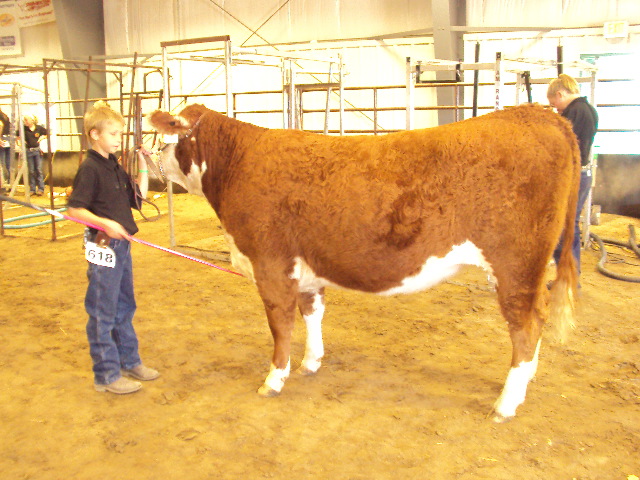
Well, after that fulfilling week in Olds, I came home to catch up on some sleep, relax a bit and get ready for the week after for our trip up to Saskatoon Saskatchewan for the 2011Canadian Junior Hereford Bonanza July 26-31. Every year this show is hosted by a different province and this year it was a huge success with our highest numbers ever. My siblings and I took eight head on the long almost seven hour drive to Saskatoon. It is quite similar to Summer Synergy with different activities like showmanship, judging, grooming and team competitions happening throughout the week with the big open show at the end! I did alright in the show this year with my yearling heifer placing third in the class and the 2 year old bull 40W, featured here received the honor of reserve champion senior bull!
Well, after that fulfilling week in Olds, I came home to catch up on some sleep, relax a bit and get ready for the week after for our trip up to Saskatoon Saskatchewan for the 2011Canadian Junior Hereford Bonanza July 26-31. Every year this show is hosted by a different province and this year it was a huge success with our highest numbers ever. My siblings and I took eight head on the long almost seven hour drive to Saskatoon. It is quite similar to Summer Synergy with different activities like showmanship, judging, grooming and team competitions happening throughout the week with the big open show at the end! I did alright in the show this year with my yearling heifer placing third in the class and the 2 year old bull 40W, featured here received the honor of reserve champion senior bull! Bonanza is probably one of my favorite parts of summer, I have been going since 2008 when Alberta hosted it in Medicine Hat and I have loved it ever since. It is another great way to meet fellow junior members that love to show and raise the Hereford breed! Again I encourage any Hereford enthusiasts under the age of 21 to come out and have fun with us, it is another great opportunity for scholarship money, free semen through the semen donation program and the chance to win money for a heifer through the heifer lottery, all you have to do is become a Canadian Junior Hereford Member.
It has been a great month, quite an exhausting one and I'm still catching up on sleep but it has totally been worth it.
| Team Alberta |
Labels:
Bonanza,
cattle,
cattle show,
Herefords,
travel
Monday, 11 July 2011
Bull Pulling!
We send them all out separately but at the same time so that they can all get used to each other at once. If you have a group of bulls and then you just add another one sometime later sometimes they will gang up on the bull that is new. So, our herd bulls spent the first day or so fighting to see who would be the boss of them all, it's just what they do and is quite natural. But, after a while they do settle down and that is why they are also in a big field so they can spread out if they have to and close to home so that we can check on the regularly to make sure no one gets injured or sick in the chaos. We also moved some cows together, as it is a whole lot easier to check eight or nine bunches of cows rather than seventeen of them, and now with the bulls gone we can put more of them together.
So, that was the big deal this weekend, another breeding season is over and new life's are growing. Sunday was spent with the extended family celebrating a Birthday and Graduation but he rest of the weekend and Monday was mostly spent haying and getting ready for the big Summer Synergy Show. It's been a busy couple of days but not as busy as the rest of the week is going to be!
Friday, 8 July 2011
A Day of Golf
| Daniel was practically a pro at golfing. |
The golf tournament is a fundraiser for the Keith Gilmore Foundation, which is a foundation that gives up to ten scholarships to post secondary students in Canada that are in the fields of agriculture, veterinary medicine, and agriculture journalism. I was one of the recipients last year, so I was asked to give a little speech about myself this year, so I had to go up their anyway so I decided may as well do a little golf. It is a great day spent with friends having a little fun golfing, and for a very worthy cause.
For more information on the Keith Gilmore Foundation go here and if you are a Canadian student taking post secondary in agriculture apply for the scholarship, every student likes scholarship money!
Monday, 4 July 2011
Invention Monday - BBQ
We haven't used it for years but it hasn't just been sitting around the last little while. The BBQ has roasted pigs for a couple weddings and has been borrowed for a couple other occasions to all withing the last year or so. A few features of the BBQ are:
- The heat comes from the side not the bottom therefore doing a better job of roasting the animal.
- There is a pan that slopes at the bottom of the BBQ so that the grease from the animal drains rather than flare up the BBQ.
- It is not a whole BBQ but can be dismantled and put back together for easier management.
Wednesday, 29 June 2011
Gophers!
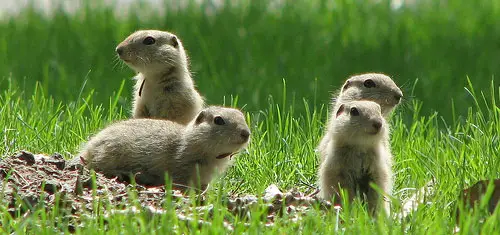
There is a little rodent that runs around called a Richardson Ground Squirrel but I are most commonly referred to as gophers. They cause havoc and are a bit of a problem in the agriculture industry. We have thousands and thousands of gophers in our pastures and we do have to do something about it to control them. Some of you may not agree with killing them but I have to give you my side of this problem. Gophers do two things that cause problems:
So, we do get rid of those annoying creatures, and there are a whole lot more than just 1000 of them, we have one field this year that is really bad, with thousands and thousands of them. And it doesn't seem to matter how many we get rid of, next year there is always another million of them. They are like a never ending problem in our area that we try to take care of as best we can!
- Gophers dig holes - They dig them everywhere, making mounds of dirt and tearing up grass. This is an issue in the well being of our cattle, they can hurt themselves if they walk in a gopher hole. It becomes more of an issue during breeding season when they ride each other, it's easier to hurt themselves if they step in a hole while riding.
- Gophers eat grass - They eat grass and pasture land, basically what our cows eat. Now one little gopher doesn't make much of a difference, but all together they do. A gopher weighs about a quarter of a pound, and will eat about seventy-five percent of their body weight. So, 0.25*0.75=0.1875 pounds a day. If their is just 1000 gophers together they are eating 0.1875*1000=187.5 pounds of grass. Now cows will eat about 1.4-4.0% of their body weight a day depending on the quality of food. So a 1200 pound cow would eat between 17-48 pounds of dry basis feed. So, just a thousand gophers, are eating about 11 or so cows feed a day! That is a lot!!
| Image |
Tuesday, 28 June 2011
A little Supplementation!
As I've mentioned before all our cows are out on pasture for the breeding season and they have been keeping us busy with regular checks. Checking everyone on a regular basis is very important to make sure all animals are healthy and making sure they have pasture, moving them when they run out.
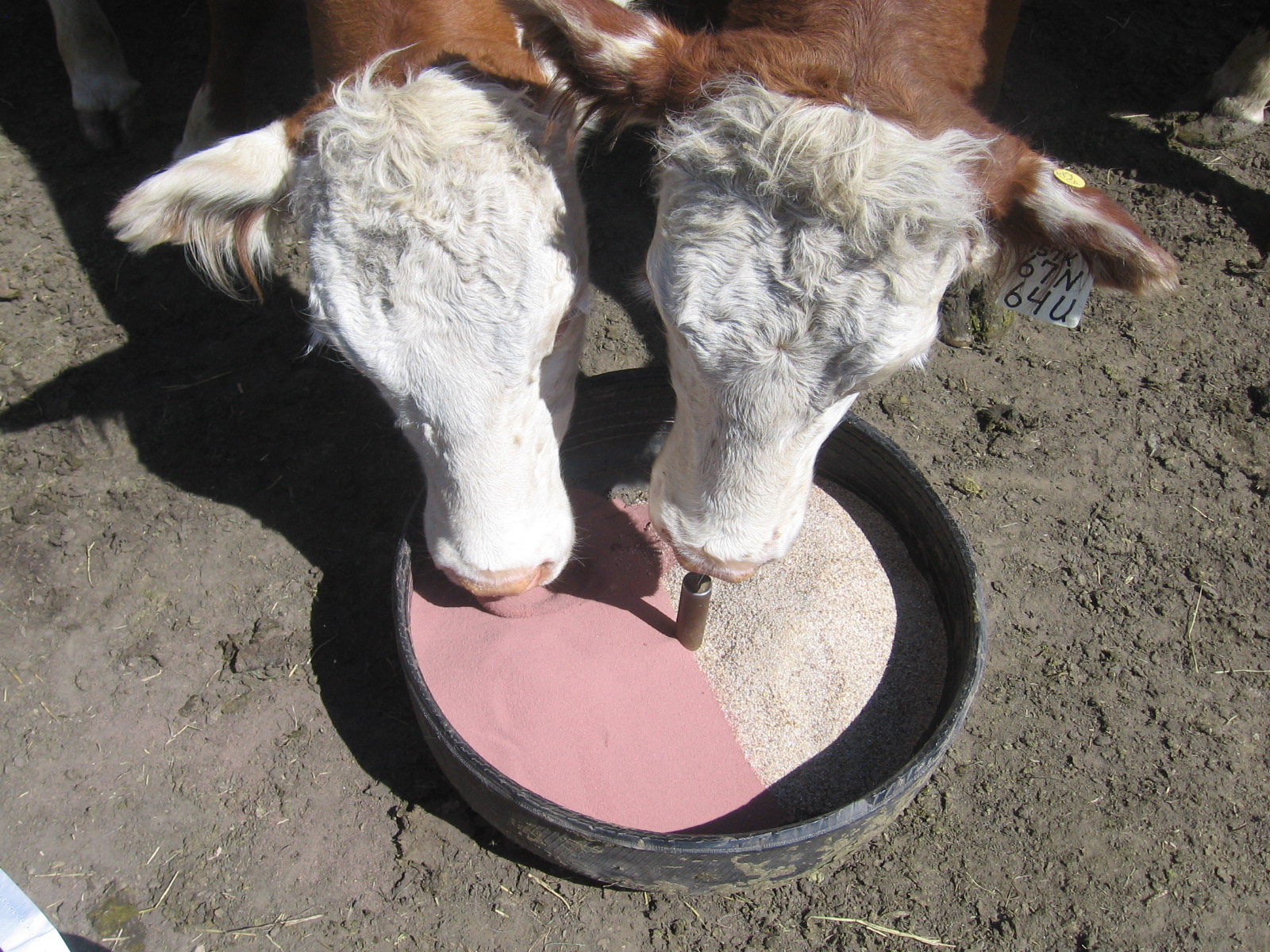
These supplements are very important to a cows diet, especially during summer pasture and when lactating milk to raise their calves. So, it is very important to make sure that they have a constant supply of salt and mineral. And luckily the cattle absolutely love the stuff, it is usually a mad dash when giving them mineral to get to the tub first!
![]()
| Salt (red) and seven way |
On a regular basis we also fill up tubs with mineral and salt as a supplementation and is very important to the cattle's diet. We have three different types of mineral that we give the cows:
- Our soil is extremely low in cooper and zinc so we feed them a hi-boot cooper and zinc salt that supplies them with the loss in the feed they eat. It also has traces of magnesium which is also a deficiency in cattle.
- The mineral we feed with the salt is an ALT-GEN 17-17 Beef and Range Mineral which contains mainly calcium and phosphorus for the cattle's diet.
- Some of our pastures contain alfalfa which is a legume plant that grows purple flowers and will grow several times during the summer if grazed down. One problem that alfalfa can cause though is bloat in animals, which is when the stomach becomes overstretched by excess gas content and if not caught and treated quickly the animal will usually die. So to prevent this cows in alfalfa pastures get seven way mineral which contains vitamins and minerals that prevent bloat.
Monday, 27 June 2011
Invention Monday - Shredder
This invention is one that saves a fair about of time and one that we use a lot. I have never had the privlege of driving this big truck, I have however had the honor of opening gates in cold weather for the person in the shredder so that it would save even more time. Unfortunatly the shredder has been in the shop for a while now getting fixed, hopefully it willwork again soon because it is a pretty important part of the ranch, especially come winter time so the wonderful cows and calves don't freeze! Here is a little video of the truck in action.
For more info on this great machine go here.
Sunday, 26 June 2011
Numbers Galore
A few days ago I did a blog on ultrasounding carcass traits in animals and had mentioned EPD's, today I will go into a little more depth on EPD's.
EPD stands for expected progeny differences. Here is an example of EPD's for an animal. To some of you this may look like just a bunch of numbers, I will do my very best to explain what the numbers are and mean.
![]()
The row at the bottom is the average EPD's of all the calves born in 2009 of the Hereford breed. An average is made every year of the calves and is used as a guideline to compare an animal to the average. EPD's of different breeds cannot be compared because each breed has their own methods of calculating EPD's and they are simply not comparable.
EPD's are a lot of numbers but are very useful in choosing herd sires to breed cows to. Through EPD's breeders can also increase the productivity and characteristics of their herd. They are also used to decide which cows to put with which bulls, for example if one cow has a low milking EPD, then we would stick her with a bull that has an above average, high milking EPD and the calf should average out and increase in milking EPD. EPD's are useful in herd management and are starting to be used more by breeders in their herd and in selecting bulls. Please comment and let me know if you have any questions!
Credits: http://www.hereford.ca/performance.asp
http://www.hereford.ca/association_member/PDFs/forms/calving_ease.pdf
EPD stands for expected progeny differences. Here is an example of EPD's for an animal. To some of you this may look like just a bunch of numbers, I will do my very best to explain what the numbers are and mean.
- Calving Ease - is an EPD that has a multitude of factors that impact calving ease from gestation period, feed, climate, cow size to breed. Calving ease is how well a cow will calf, we want calving ease to be higher so that most of them will be unassisted.
- Birth Weight is the EPD that gets calculated using the birth weights of the bulls and cows progeny as well as the calves birth weight. The lower the number the better. This bull for example has a birth weight EPD of +3.6 and he is used on cows. Our one heifer bull has a birth weight EPD of -1.1 which is low and part of the reason he is used on heifers because you want heifer's calves to have low birthweights so that they can easily calf and don't need assistance.
- Weaning weight is based on the weight of the calf's and its parents weight at weaning (when we take the calves away from the moms). In this case it is the higher the number the better. For example if another bull at an EPD of 0.0 this bull with the weaning weight of +55.8 will sire offspring with an average of 55.8 pounds heavier at weaning then the bull with an EPD of 0.0.
- Yearling weight is the same as weaning only it applies to when the animal is a year old.
- Milk is another one of those EPD's that you want higher numbers. You can't have a cow that doesn't produce any milk so you want high EPD's, it is a measure of the amount of pre-weaning performance gained by calves which can be attributed to the milking ability of a bull's/cow's daughters. The EPD is expressed in pounds of calf.
- Total Maternal is half the weaning weight plus the milk of the mother.
- Maternal Calving Ease is the calving ease of the mother.
- Scrotal Circumference is determined and adjusted from the yearling scrotal circumference of a bull's or cow's progeny, in centimeters and again the higher the EPD the bigger the better.
- Cow Weight is the EPD of the cow weight.
- Stayability is the probability that a bulls daughters will stay in the herd for so many years.
- MPI is maternal productivity index.
- FMI is feedlot merit index
- Fat is determined from the ultrasound measurements and the lower the number the less fat the animal has and the better.
- REA is the rib eye area EPD also from ultrasound, higher numbers mean larger rib eyes.
- MARB is the marbling of the animal also determined from the ultrasound with higher EPD numbers also meaning more marbling.
The row at the bottom is the average EPD's of all the calves born in 2009 of the Hereford breed. An average is made every year of the calves and is used as a guideline to compare an animal to the average. EPD's of different breeds cannot be compared because each breed has their own methods of calculating EPD's and they are simply not comparable.
| EPD's showed graphically in percentiles. |
Credits: http://www.hereford.ca/performance.asp
http://www.hereford.ca/association_member/PDFs/forms/calving_ease.pdf
Subscribe to:
Posts (Atom)